
LEGAL DISCLAIMER
Please note: This article is for informational purposes only and does not constitute legal advice. Every business is different, and the laws that apply to your website depend on your specific circumstances. We strongly recommend consulting a qualified attorney to understand your obligations.
If you’ve ever wondered about website privacy policy requirements – what you actually need, what’s legally required, and what happens if you skip it – you’re not alone. Whether you’re running a local service business, an e-commerce shop, or a nonprofit, the legal landscape around website policies has shifted significantly in the past few years, and the consequences of ignoring it are real. This guide breaks it all down without the legal jargon.
“Most small business owners don’t skip website policies because they don’t care – they skip them because nobody explained what they actually need, or why.”
Website policies are legal documents that govern the relationship between your website and the people who use it. Think of them as the fine print that most people don’t read – until something goes wrong. They exist to protect both parties: they tell visitors how their data is being collected and used, and they protect you from liability if something on your site causes a dispute.
There are four core policies every website should have on its radar:
Explains what personal data you collect (names, email addresses, IP addresses, browsing behavior), how you use it, who you share it with, and how users can request its deletion. Importantly, a Privacy Policy isn’t one-size-fits-all – the specific disclosures it needs to contain depend on which privacy laws actually apply to your business and your visitors.
(Also called Terms and Conditions) Sets the rules for using your website: what users can and can’t do, your intellectual property rights, limitations on your liability, and what happens if there’s a dispute.
Clarifies the limits of your responsibility for the information on your site. Especially important if you offer advice, resources, or product recommendations.
Explains what cookies your site places on a visitor’s browser, why you place them, and gives visitors the ability to manage their preferences. While a Cookie Policy can be incorporated into your Privacy Policy, it can also stand as its own document – more on this below.
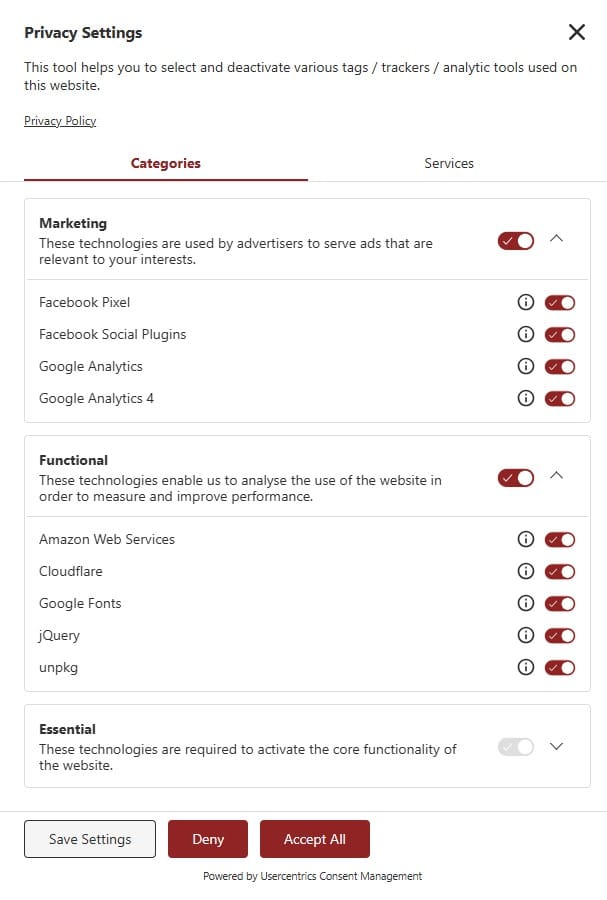
Now, are all four required? That depends on where you are, who your visitors are, and what your website actually does. Let’s break it down.
For the vast majority of websites, a Privacy Policy is either legally required or practically unavoidable. Here’s why: there is no single federal privacy law in the United States that applies to all websites, but there is a growing patchwork of state laws that collectively create a very broad obligation. California’s CalOPPA (California Online Privacy Protection Act) applies to any website that collects personal data from California residents – regardless of where your business is based. If anyone in California visits your site and fills out a contact form, you’re in scope.
On top of state laws, the platforms and tools you almost certainly rely on require it. If you use Google Analytics, Google Ads, or Meta Pixel, those platforms explicitly require you to have a Privacy Policy in place. Apple requires one for any app in their App Store. If you send marketing emails, the CAN-SPAM Act has disclosure requirements that tie back to your Privacy Policy too.
“If your website has a contact form, collects emails, or runs any kind of analytics – you need a Privacy Policy. That covers virtually every website built in the last decade.”
The good news is that having a Privacy Policy isn’t just about avoiding legal exposure – it’s also a trust signal. Visitors are increasingly savvy about data privacy, and a clearly written, accessible policy tells them you take their information seriously. That matters, especially for service-based businesses where the entire relationship is built on trust.
This one surprises a lot of people. The US does not have a federal law requiring cookie consent banners – unlike in the EU, where the GDPR and ePrivacy Directive together mandate explicit opt-in consent before any non-essential cookies are set.
At the federal level, the US generally follows an opt-out model rather than opt-in. https://www.cookieyes.com/blog/us-cookie-consent-requirements/ However, this is not the full picture – and it’s an important distinction. A growing number of states have enacted their own privacy laws with specific cookie and tracking requirements. California is the most prominent example: CIPA (California Invasion of Privacy Act) effectively requires that users are opted out of certain data collection by default, and CIPA-based demand letters are skyrocketing – targeting site owners of all sizes, including nonprofits and solo operators. But California isn’t alone. Colorado, Connecticut, Virginia, and a growing list of states have their own requirements around opt-out mechanisms, consent banner design, and browser privacy signals like Global Privacy Control (GPC). The regulatory landscape is expanding rapidly, and what isn’t required in your state today may well be required tomorrow.
In practical terms, a cookie banner is the cleanest way to meet that obligation – and it’s effectively required if your site uses retargeting or advertising pixels (Meta, Google, LinkedIn), participates in behavioral ad networks, or sells or shares visitor data with third parties. Several state laws – including the California Consumer Privacy Act (CCPA) and similar laws now active in over 20 states – require a “Do Not Sell or Share My Personal Information” mechanism to be visible and functional on your site.
And if you have any international visitors? GDPR applies to them, which means opt-in consent is required for those users. The cookie banner handles all of this gracefully in one place.
First, an important clarification: privacy and data laws apply to all website owners – regardless of industry, business size, or whether you operate as a for-profit or nonprofit. There is no exemption for being small, new, or well-intentioned. CIPA demand letters, for example, have targeted solo operators, small nonprofits, and large enterprises alike. That said, some industries carry additional legal obligations on top of the baseline that make compliance even more critical:
Even if your industry isn’t listed here, the general rule holds: if your site collects any information from visitors, you need a Privacy Policy. Every site owner is subject to the laws applicable to their situation – the question isn’t whether the law applies to you, but which laws apply and what they require.
A Privacy Policy gets most of the attention, but it’s only one piece of the puzzle. Here’s what else belongs on your site – and why.
A Terms of Service agreement might seem like overkill for a small business, but it does a surprising amount of heavy lifting. It limits your liability if a visitor misuses your content, sets clear expectations about how your intellectual property can (and can’t) be used, establishes dispute resolution terms, and governs the behavior of any users who interact with your site. If you sell products, offer subscriptions, or let users create accounts, it’s not optional.
Disclaimers are the most overlooked of the four policies, and often the most relevant for service businesses. If your website contains advice – financial, legal, medical, creative, or otherwise – a disclaimer clarifies that your content is for informational purposes only and shouldn’t be taken as professional guidance specific to any individual’s situation. It’s a simple document that can save significant headaches.
“A disclaimer doesn’t mean you’re hedging. It means you’re being honest about the scope of what you’re offering – and that’s actually a mark of professionalism.”
A Cookie Policy explains what cookies your site places on a visitor’s browser, why you place them, how long they persist, and whether any third parties have access to them. While Cookie Policy disclosures can be incorporated into your Privacy Policy, a standalone Cookie Policy gives you more room to be specific and transparent – which is increasingly expected by both visitors and regulators. If your site uses any form of tracking, analytics, or advertising technology, a Cookie Policy is an important part of your compliance picture.
The honest truth is that hiring an attorney to draft your policies, monitor legal changes, and keep everything current over time is the gold standard. A qualified privacy attorney understands the nuances of the laws that apply to your specific situation in a way no template can replicate. The challenge, of course, is cost – ongoing legal retainers are out of reach for most small businesses. That’s exactly the gap that tools like Termageddon are designed to fill.
Here’s where a lot of small businesses trip up: they find a Privacy Policy template online, copy it, paste it into their footer, and assume they’re covered. The issue is that website policies need to reflect what your site actually does – and they need to stay current as laws change. A policy written in 2019 probably doesn’t account for the wave of new state privacy laws that took effect in 2023, 2024, and 2025. A policy that doesn’t match your actual data practices isn’t just inadequate – it can actively work against you if it’s ever scrutinized.
This is exactly why we recommend Termageddon to many of our clients. Termageddon is a policy generator that produces legally reviewed policies tailored to your specific website and business, and – critically – updates them automatically as the laws change. You’re not buying a static document; you’re subscribing to ongoing legal compliance. We’re a Termageddon affiliate, which means we may receive a commission if you sign up through our link, but we recommend it because it genuinely solves the problem well. If you’d like us to handle the setup for you, we offer Termageddon integration as part of our Site Management services, with preferred pricing available for clients. Alternately, if you would prefer to signup directly with Termageddon, you can just enter the promo code NOPANIC when you begin your subscription to receive a 10% discount on your first year subscription price.
Having the policies is only half the job – they need to be findable. At minimum, links to your Privacy Policy and Terms of Service should appear in your footer on every page of your site. Your cookie banner (if applicable) should appear on first visit, with a clear and functional opt-out mechanism. Don’t bury them. Don’t put them in white text on a white background. Legal compliance isn’t just about having the documents – it’s about making them genuinely accessible to your visitors.
As a reference point, you can see how No Panic Design handles this on our own Privacy Policy – clear, readable, and accessible from the footer of every page on the site.
Website policies are one of those things that are much easier to put in place before you have traffic than to retrofit after the fact. If you’re building a new site, your policy setup should be part of the pre-launch checklist, not an afterthought. At No Panic Design, we walk every client through this as part of the project process, because launching without proper policies in place isn’t a risk worth taking.
If your site is already live and you haven’t addressed this yet – don’t panic. It’s fixable. But it’s also urgent. The regulatory environment is only getting more complex, not less, and the cost of getting it right now is far lower than the cost of a complaint or investigation later.
“Launching without website policies is a bit like opening a shop without a sign – technically possible, but not a great look, and probably not legal for long.”
Whether you tackle this yourself, work with a tool like Termageddon directly, or hand it off to us as part of a broader site management engagement, the important thing is that you tackle it. Your visitors deserve to know how their data is being handled – and you deserve the peace of mind that comes with knowing you’re covered.
Ready to sort out your website policies properly? Get in touch with No Panic Design – we’d be glad to help.
Disclosure: This post contains an affiliate link and discount code to Termageddon. We may receive a commission at no additional cost to you. We only recommend tools we use and trust.
Website:
https://www.nopanicdesign.com
LinkedIn:
https://www.linkedin.com/company/no-panic-design
Instagram:
https://www.instagram.com/nopanicdesign
Facebook:
https://www.facebook.com/nopanicdesign